Mother colonies to endpoints, under one roof in Brittany.
Coral mother colonies, in-house cutting production, testing, and assessment, all under one roof in Arzal, Brittany. Our lab doesn't sample wild reefs and doesn't depend on external coral sourcing. The same lab serves cosmetic formulations and marine / industrial ecotox programs.
Reviewed by Vincent Bourgeteau, President
Vincent Bourgeteau is a biologist and President of ReefTox (EcoSeaStems SAS), a closed-loop coral ecotoxicology laboratory in Brittany, France.
Inside the closed loop

50
Coral species (up to)
30
Coral genera
3
Ocean regions covered
2-3
Week acute turnaround
Indo-Pacific, Caribbean, and Mediterranean. Hard SPS, hard LPS, and soft corals.

Methodology
Acute and chronic coral protocols, quantified end to end.

Acute
96-hour contact, with 6 replicates and 6 blanks per concentration. 50 mg/l realistic-exposure standard concentration. Renewal at 48h.
Endpoints: EC50, LOEC, NOEC.
Chronic
3 months of exposure plus 1 month of recovery across 5 concentrations (EC determination) plus 1 concentration (confirmatory). Three lunar cycles, the minimum for biologically meaningful chronic results.
Endpoints: EC10, EC50. Chronic PNEC where the use case requires it.
Quality controls
Annual positive controls run with both mineral and organic UV filters. Fresh coral fragments per test, no reuse. Every endpoint quantifiable and auditable.
Measured parameters
Bleaching (computer-assisted), tissue loss, mortality, morphological and behavioural anomalies (polyp debilitation, mesenteric filament ejection), before/after photography.
Acute pre-validation across 13 laboratories in 6 European countries is documented in Bao et al. 2024 (Toxics 12(1):1).
Inside the lab
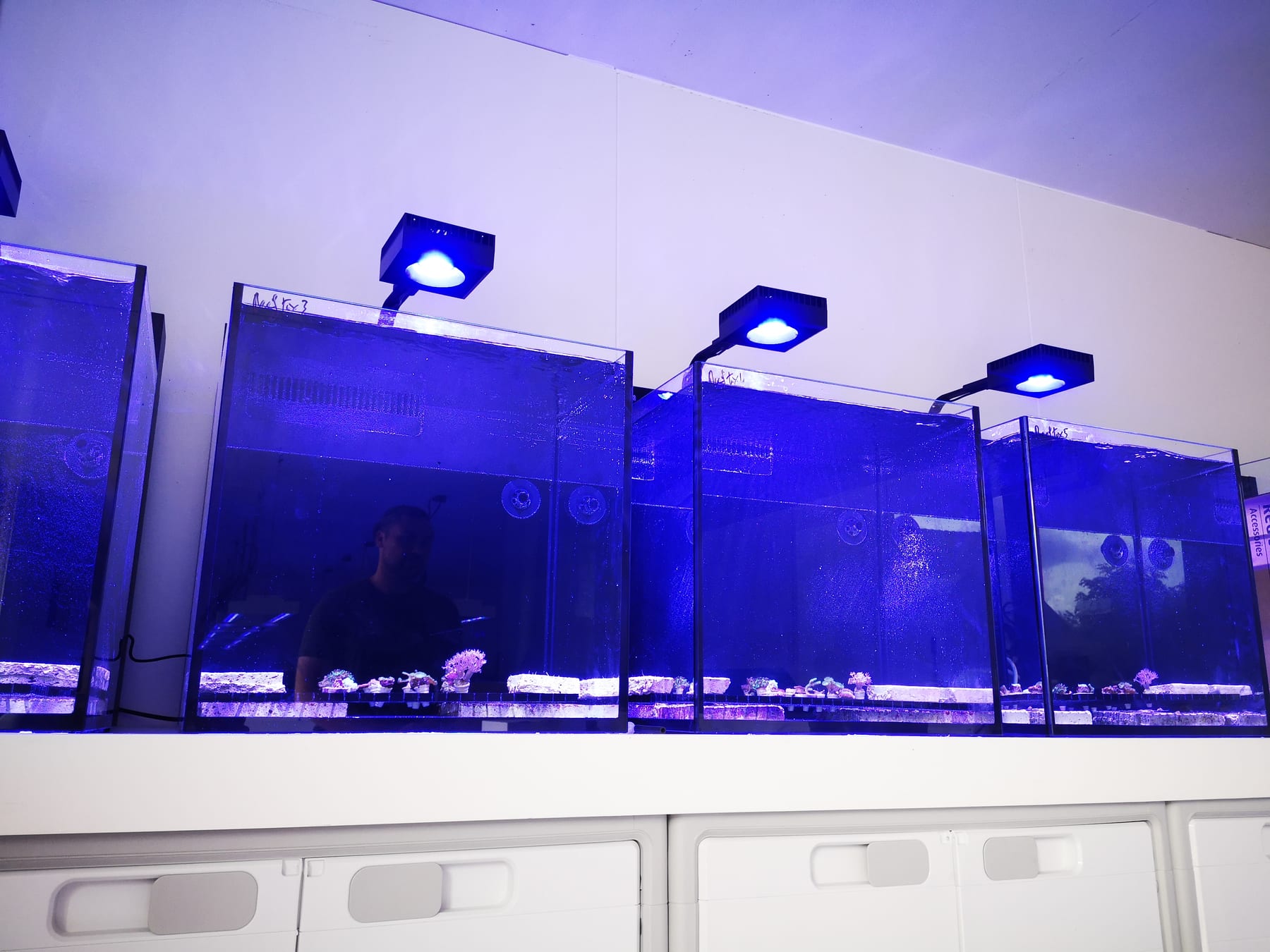
Inside the ReefTox closed-loop lab, Arzal, Brittany. Reef husbandry systems where coral mother colonies are cultivated, next to the bench where exposure racks are prepared.
Why closed-loop
We cultivate our own corals because the rest of the chain depends on it.
No wild sampling
Mother colonies are cultivated on site. Cuttings are produced in-house. Our methodology does not deplete reef ecosystems.
No external dependency
Husbandry, cutting production, testing, and assessment are all under one roof, which is why the acute turnaround is 2-3 weeks instead of 12-16.
Taxonomic depth
Up to 50 species across 30 genera, hard SPS, hard LPS, and soft corals, representative of Indo-Pacific, Caribbean, and Mediterranean reef ecosystems.
Which side of the lab do you need?

Cosmetics & SPF
Test a cosmetic formulation or SPF ingredient →
Free predictive pre-evaluation, then live-coral testing documented in a defensible coral ecotox report.
Marine & Industrial
Add coral to your marine ecotox program →
Antifouling, ballast, scrubber, drilling, cruise. Scoping call, no public price list.